Одиннадцатая стадия (випашьяна) The Eleventh Stage (Vipashyana)
Випашьяна, основанная на шаматхе, искореняет клеши (омрачения). Зная это, сперва устремись к шаматхе.
© Шантидэва «Бодхичарья-аватара» 8:4
Шаматха не является конечной целью, она не устраняет страдания, чтобы устранить страдания, нужно развить мудрость (випашьяна на санскрите, випассана на пали, лхатонг по-тибетски). Слово «випашьяна» переводится как «видеть мир таким какой он есть» (а не таким, каким он нам видится из-за наших кармических отпечатков). Практика випашьяны приносит мудрость (то есть способность видеть мир таким какой он есть, осознавать непостоянство всех явлений и т.д.).
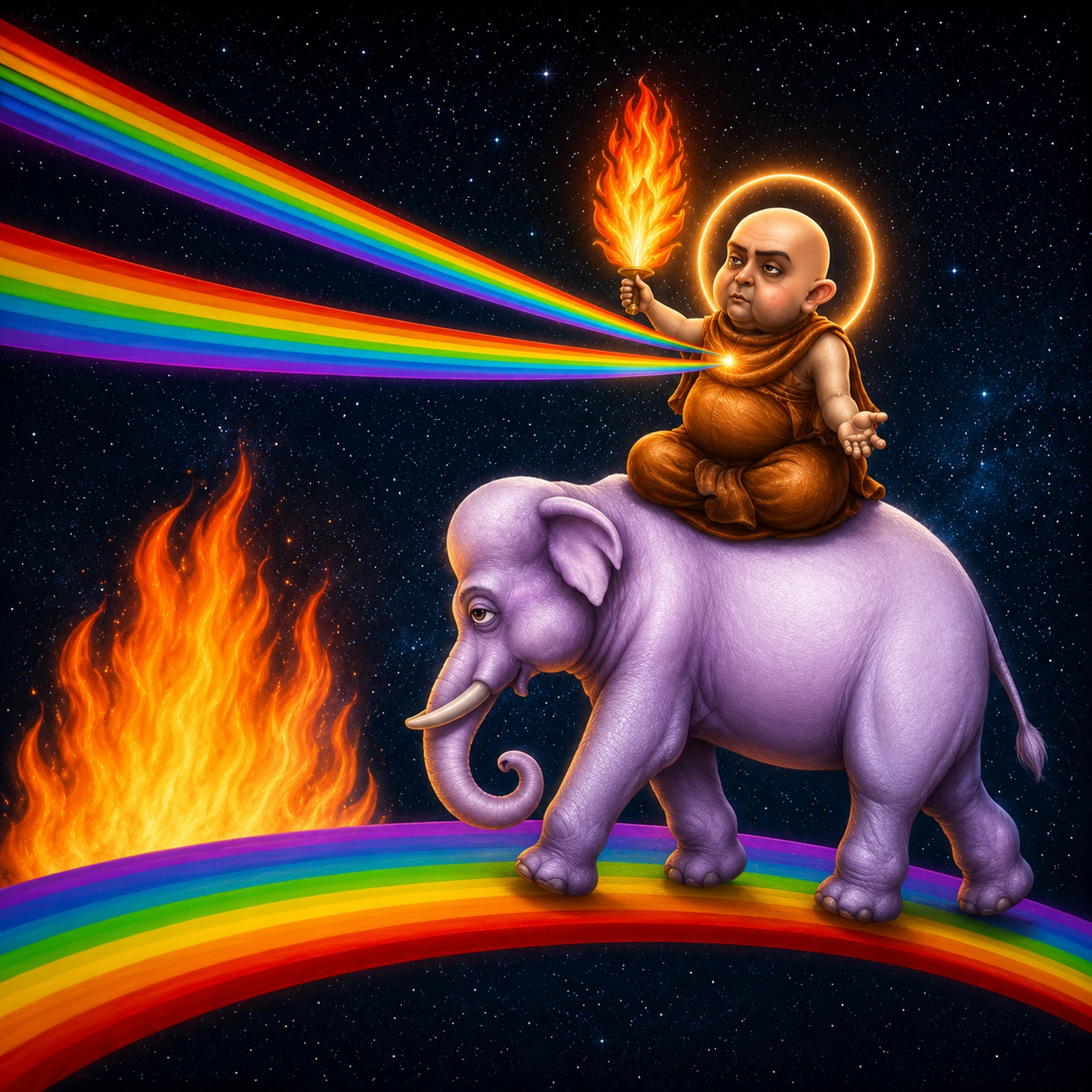
Огонь на картинке — это вновь появившаяся энергия, непосредственное Постижение, а огненный меч — проникающее Постижение (мудрость). Едущий на слоне монах держит меч мудрости, уничтожающий причину страданий, из его сердца выходят два радужны луча самскар (кармических отпечатков, мешающих видеть мир таким какой он есть), монах рубит их мечом мудрости. Когда причина страданий устранена обретается освобождение.
Почему у монаха из груди выходит две радуги? Я так и не смогла найти ответ на данный вопрос ни в одном из источников, но более опытные практики поделились предположением, что радуги символизируют рассеивание двух завес: завесы омрачений (клеша) и завесы к всеведению (авидья). Вторая более тонкая.
В Махаяне есть концепция двух путей и двух плодов, в зависимости от цели. Если цель – освобождение только себя, то это путь шравака, а плодом будет архатство шравакаяны. Если цель – освобождение всех существ, то это путь бодхисаттвы, а плодом будет пробуждение будды (просветленного).
Чтобы достичь первой цели, достаточно устранить завесу омрачений (клеша). Архаты реализуют нирвану (освобождение от сансары), но не имеют всеведения будд. Всеведение необходимо, чтобы эффективно помогать другим существам. Для этого практики зарождают бодхичитту (стремление к просветлению, чтобы помочь всем живым существам избавиться от страданий) и развивают парамиты (благие качества, такие как щедрость, терпение, мудрость и т.д.).
Чтобы лучше понять действие самскар (кармических отпечатков) можно рассмотреть следующую притчу. На берег Ганги приходят трое: голодный дух, человек и бог. Голодный дух видит в реке нечистоты, человек — воду, а бог — нектар блаженства и бессмертия. Из-за разных качеств ума каждый видит что-то свое, но если все трое видят разное, то чем на самом деле является река?
Таким же образом у каждого человека в зависимости от качеств ума есть свое мировоззрение с заблуждениями и представлениями разной степени истинности. У каждого человека бывает так, что он ошибается в других людях, не до конца понимает ситуации и неверно оценивает риски. Все это из-за того, что восприятие загрязнено самскарами. Випашьяна — это совершенное видение, не загрязненное кармическими отпечатками.
Vipashyana, based on shamatha, eradicates the kleshas (afflictions). Knowing this, first strive to attain shamatha.
© Shantideva «Bodhicaryavatara» 8:4
Shamatha is not the ultimate goal. It does not eliminate suffering; to eliminate suffering, one must develop wisdom (vipashyana in Sanskrit, vipassana in Pali, lhaktong in Tibetan). The word «vipashyana» is translated as «seeing the world as it really is» (rather than as it appears to us because of our karmic imprints). The practice of vipashyana brings wisdom (that is, the ability to see the world as it really is, to recognise the impermanence of all phenomena, and so on).
The fire in the image represents newly awakened energy and direct Insight, while the flaming sword represents penetrating Insight (wisdom). The monk riding the elephant holds the sword of wisdom, which destroys the cause of suffering. Two rainbow rays of samskaras (karmic imprints that prevent us from seeing the world as it really is) emerge from his heart, and the monk cuts through them with the sword of wisdom. When the cause of suffering is eliminated, liberation is attained.
Why do two rainbows emerge from the monk’s chest? I was unable to find an answer to this question in any source, but more experienced practitioners suggested that the rainbows symbolise the dispersal of two veils: the veil of afflictions (klesha) and the veil obstructing omniscience (avidya). The second is subtler.
In Mahayana, there is a concept of two paths and two fruits, depending on the goal. If the goal is to liberate oneself alone, this is the path of the shravaka, and its fruit is the arhatship of the Shravakayana. If the goal is to liberate all beings, this is the path of the bodhisattva, and its fruit is the awakening of a Buddha (an Enlightened One).
To attain the first goal, it is sufficient to eliminate the veil of afflictions (klesha). Arhats realise nirvana (liberation from samsara), but they do not possess the omniscience of Buddhas. Omniscience is necessary in order to help other beings effectively. For this purpose, practitioners generate bodhicitta (the aspiration to attain enlightenment in order to help all living beings become free from suffering) and develop the paramitas (virtuous qualities such as generosity, patience, wisdom, and so on).
To better understand the effect of samskaras (karmic imprints), consider the following parable. Three beings come to the bank of the Ganges: a hungry ghost, a human, and a god. The hungry ghost sees filth in the river, the human sees water, and the god sees the nectar of bliss and immortality. Because of the different qualities of their minds, each sees something different, but if all three see different things, what is the river in reality?
In the same way, every person has their own worldview, depending on the qualities of their mind, with delusions and ideas possessing different degrees of truth. Everyone sometimes misjudges other people, fails to understand situations fully, and assesses risks incorrectly. All this happens because perception is polluted by samskaras. Vipashyana is perfect vision, unpolluted by karmic imprints.